MERN Stack and Mobile App Technologies: Building Modern Digital Products
Learn how MERN Stack and modern mobile app technologies work together to build fast, scalable, and user-friendly web and mobile applications for businesses.
Orbitdor Editorial··7 min read
MERN StackMobile App DevelopmentReact NativeMongoDBExpress.jsReactNode.jsFull Stack Development
What Is the MERN Stack?
MERN Stack is a popular JavaScript-based technology stack used to build modern web applications.
MERN stands for:
MongoDB Express.js React Node.js
These technologies work together to create complete full-stack applications where both frontend and backend development can be handled using JavaScript or TypeScript.
MERN Stack is commonly used for:
SaaS applications eCommerce platforms CRM systems ERP systems Real estate platforms Booking systems Business dashboards Customer portals Admin panels Custom web applications MongoDB
MongoDB is a NoSQL database used to store application data.
Instead of traditional tables, MongoDB stores information in flexible document-based structures.
React is a frontend JavaScript library used to build interactive user interfaces.
It allows developers to create reusable UI components such as:
Navigation bars Forms Buttons Cards Tables Dashboards Modals Filters Search interfaces User profiles
React is especially useful for applications where the interface changes frequently based on user actions.
Node.js
Node.js allows JavaScript to run on the server.
It is commonly used to build backend services, APIs, real-time applications, and business systems.
Node.js can handle:
API requests Authentication Database operations Real-time communication Notifications Payment processing Business workflows Background processes
Its event-driven architecture makes it suitable for many scalable web applications.
Why Businesses Choose MERN Stack
MERN Stack offers several advantages for modern software development.
One Programming Language
JavaScript or TypeScript can be used across the frontend and backend.
This helps development teams maintain a more consistent codebase.
Faster Development
Reusable components, APIs, and shared development patterns can speed up the development process.
Scalability
A properly designed MERN application can grow from a small MVP to a larger business platform.
Large Ecosystem
JavaScript has a large ecosystem of libraries, tools, frameworks, and integrations.
API-Friendly Architecture
MERN Stack works well with third-party services such as:
Payment gateways Cloud storage AI APIs Maps Email services SMS services Authentication providers MERN Stack for Mobile Applications
MERN Stack is primarily associated with web development, but the same backend can also power mobile applications.
For example, a Node.js and Express backend can provide APIs for:
Web application Android application iOS application Admin dashboard
All platforms can communicate with the same backend and database.
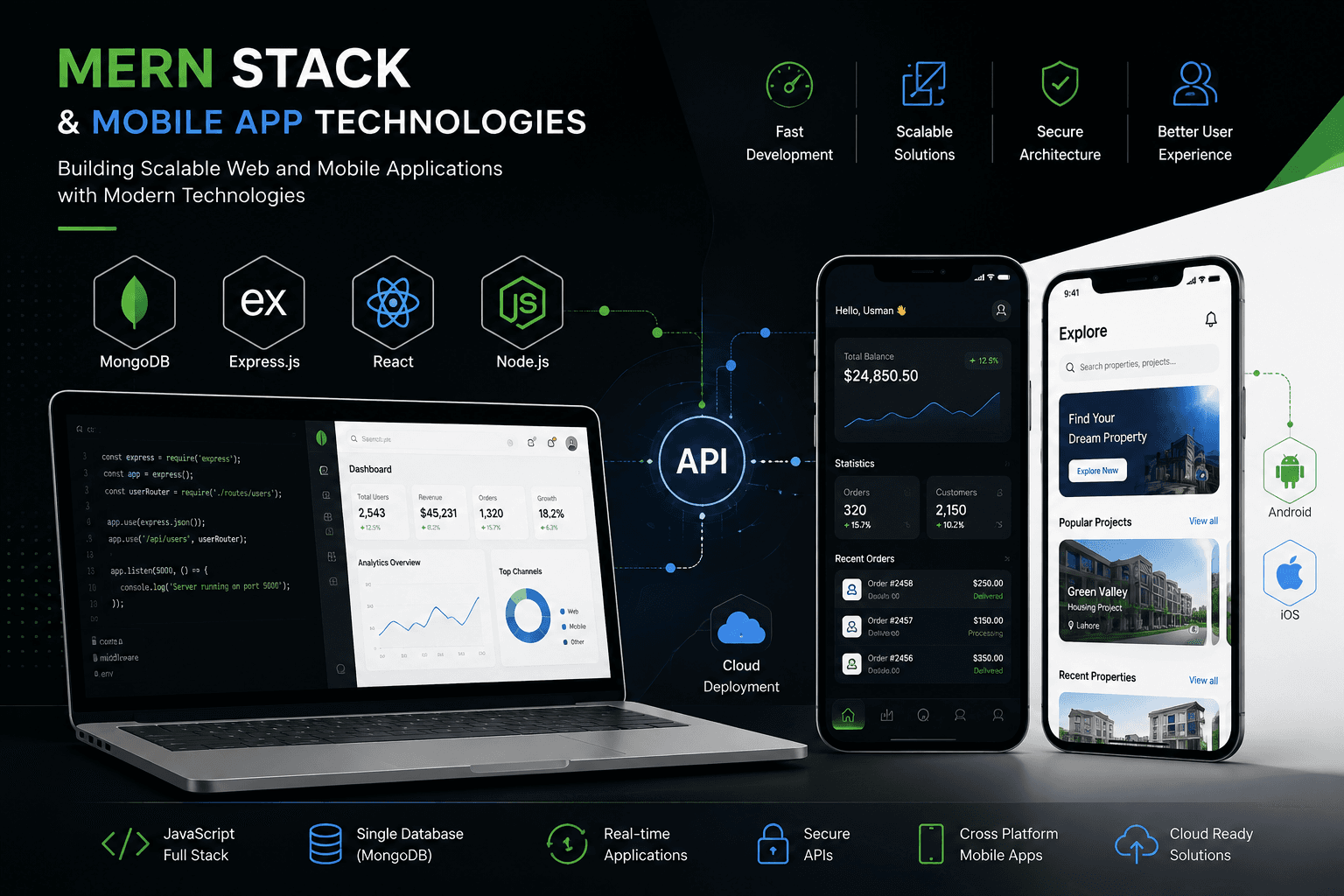
A common architecture looks like this:
Web App → React
Mobile App → React Native
Backend → Node.js + Express.js
Database → MongoDB
This allows businesses to maintain one centralized backend while serving multiple platforms.
What Is React Native?
React Native is a popular framework for building mobile applications using JavaScript and React concepts.
It allows developers to build applications for:
Android iOS
using a shared codebase.
React Native is a strong choice for businesses that already use React or MERN Stack.
Developers can reuse:
JavaScript knowledge TypeScript API services Validation logic Business logic Development patterns
This can reduce development complexity compared with maintaining completely separate mobile teams.
React Native vs Native Mobile Development
Native mobile applications are normally built using platform-specific technologies.
Android applications may use:
Kotlin Java
iOS applications may use:
Swift
React Native allows developers to build applications for both platforms with a shared codebase.
Native development can provide maximum platform-specific control, while React Native can offer faster cross-platform development for many business applications.
The best option depends on the product requirements.
Flutter
Flutter is another popular cross-platform mobile development framework.
It uses the Dart programming language.
Flutter can also create applications for both Android and iOS from one codebase.
Businesses choosing between Flutter and React Native should consider their existing development team, product requirements, and long-term architecture.
React Native with MERN Stack
React Native works especially well with MERN-based systems.
For example:
Frontend Web
React or Next.js
Mobile Application
React Native
Backend
Node.js + Express.js
Database
MongoDB
Authentication
JWT, OAuth, or another secure authentication system
Storage
Cloud storage services
This architecture allows the web and mobile applications to use the same backend APIs.
APIs Connect Web and Mobile Applications
APIs are one of the most important parts of a modern application architecture.
The mobile application should not connect directly to the database.
Instead, it communicates with secure backend APIs.
For example:
Mobile App → API → Backend → Database
This architecture allows the backend to handle:
Authentication Permissions Validation Business rules Database security
It also makes it easier to support multiple frontend applications.
Authentication in Mobile Applications
Modern mobile applications often require secure authentication.
Common methods include:
Email and password OTP login Google login Apple login Phone authentication JWT authentication Refresh tokens
Security should be implemented on the backend.
Simply hiding screens inside the mobile application is not enough.
Every protected API should independently verify whether the user has permission to perform an action.
Real-Time Mobile Features
Many modern mobile applications require real-time functionality.
Examples include:
Chat Notifications Live order updates Property inquiries Delivery tracking User activity Dashboard updates
Technologies such as WebSockets and Socket.IO can be used with Node.js to create real-time features.
Push Notifications
Push notifications help mobile applications communicate with users even when the app is not currently open.
They can be used for:
New messages Order updates Booking confirmations Lead notifications Payment reminders Promotional updates Account alerts
Push notification services can be integrated with a MERN backend.
Cloud Storage for Mobile Apps
Applications that handle images, videos, and documents should usually use dedicated cloud storage.
Examples of content that may require storage include:
Backend APIs must always validate permissions independently.
Choosing the Right Technology
There is no single technology that is best for every application.
A good development team should first understand:
Business goals Required features Expected number of users Performance needs Budget Timeline Future integrations Mobile requirements
Then the appropriate technology stack can be selected.
Web App or Mobile App?
Businesses often ask whether they should build a website, web application, or mobile application.
A web application can be easier to launch because users do not need to install anything.
A mobile application can provide deeper device integration and stronger engagement through features such as push notifications.
For many businesses, a good strategy is:
Build a scalable backend Launch the web platform Reuse the same APIs for mobile applications
This reduces duplicated development effort.
The Future of MERN and Mobile Development
Modern software development is moving toward connected platforms.
A single business may have:
Public website Web application Mobile application Admin dashboard Customer portal AI assistant
All of these systems can share centralized APIs and business logic.
This makes good backend architecture increasingly important.
Final Thoughts
MERN Stack and modern mobile app technologies provide a powerful foundation for building scalable digital products.
MongoDB, Express.js, React, and Node.js can power the core web application, while React Native or other mobile technologies can extend the same platform to Android and iOS.
The most important factor is not simply choosing popular technologies.
A successful product requires secure architecture, reusable code, scalable APIs, strong performance, and a clear understanding of business requirements.
At Orbitdor, we focus on building modern web applications, MERN Stack platforms, SaaS systems, APIs, mobile-ready backends, and digital solutions designed to scale as businesses grow.